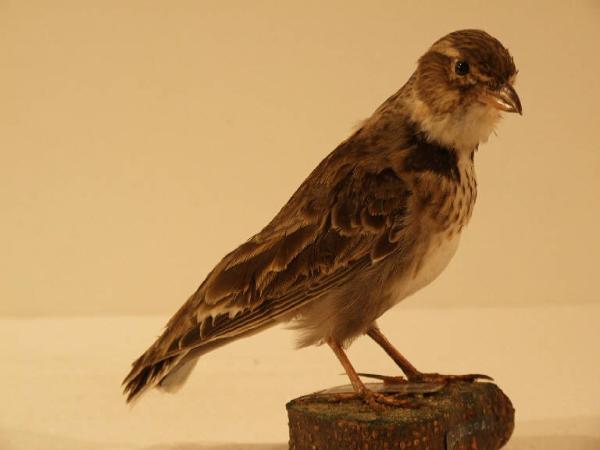
The Calandra is a large bird belonging to the Alauidae family. It is a passerine bird distinguished by its robust appearance and distinctive plumage. The calandra has a stocky build, with a length of up to 20-25 cm, with predominantly grayish-brown plumage on the back and wings, and lighter, shaded coloration on the underside, with whitish or grayish tones. The head has a crest of upright feathers, giving the bird a distinctive appearance, and has a strong, conical beak, typical of seed-feeding birds.
The male, during the breeding season, displays more vibrant plumage with more pronounced hues, while the female has more muted and less contrasting colors. The legs are short and strong, suitable for walking through tall grass.
The calandra is a bird that lives mainly in open environments, such as grasslands, cultivated fields and semi-arid areas, where it feeds on herbaceous plant seeds and occasionally small insects. It is a bird that prefers to stay on the ground, where it moves by walking rather than flying. When it flies, it does so rather directly, but it is capable of rapid changes of direction.
The calandra's song is melodious and complex, with a series of trills and high-pitched notes that are emitted especially during the nesting period, when the male tries to attract the female. The nest is usually built on the ground, among the grass, where the female lays eggs that are incubated by both parents.