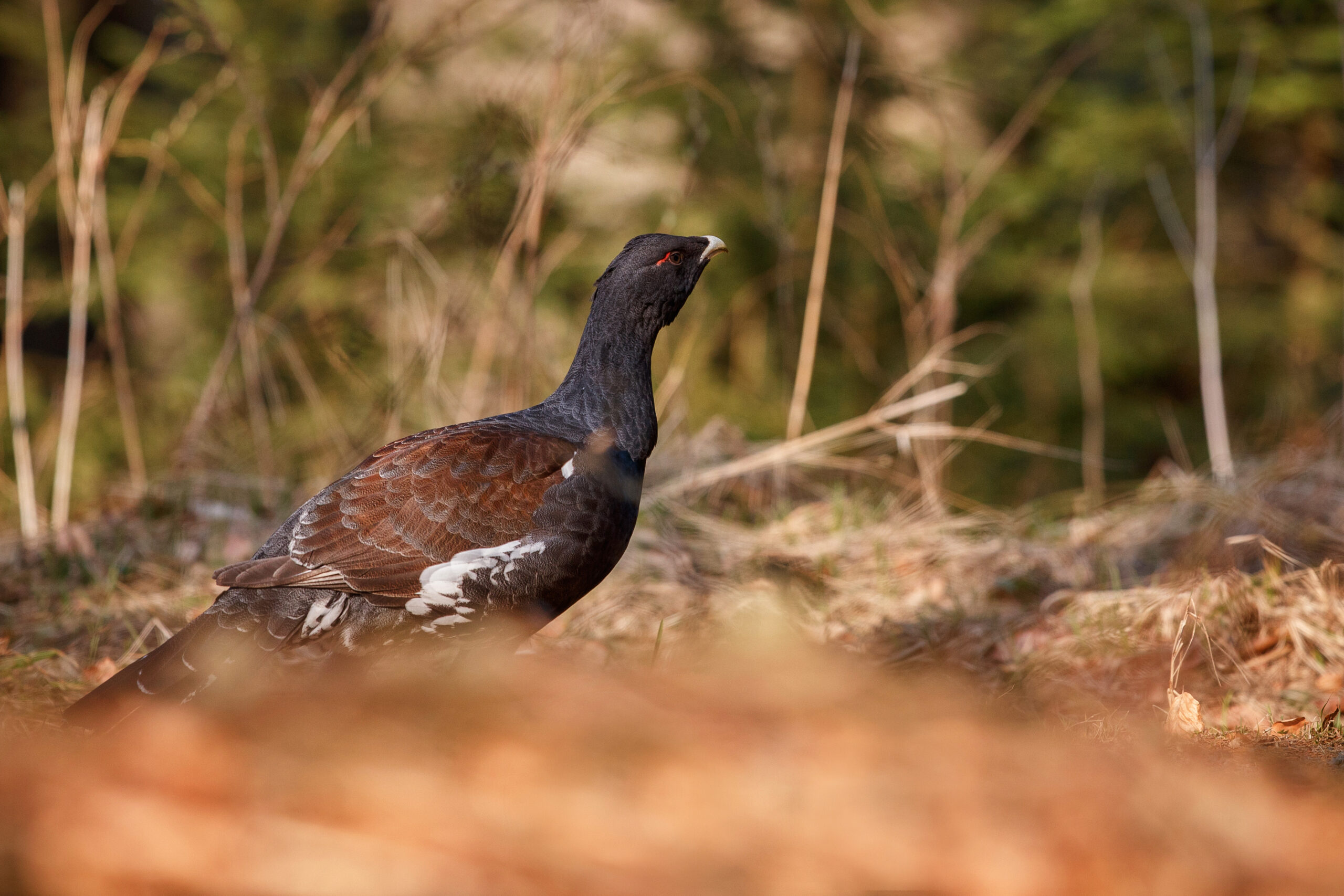
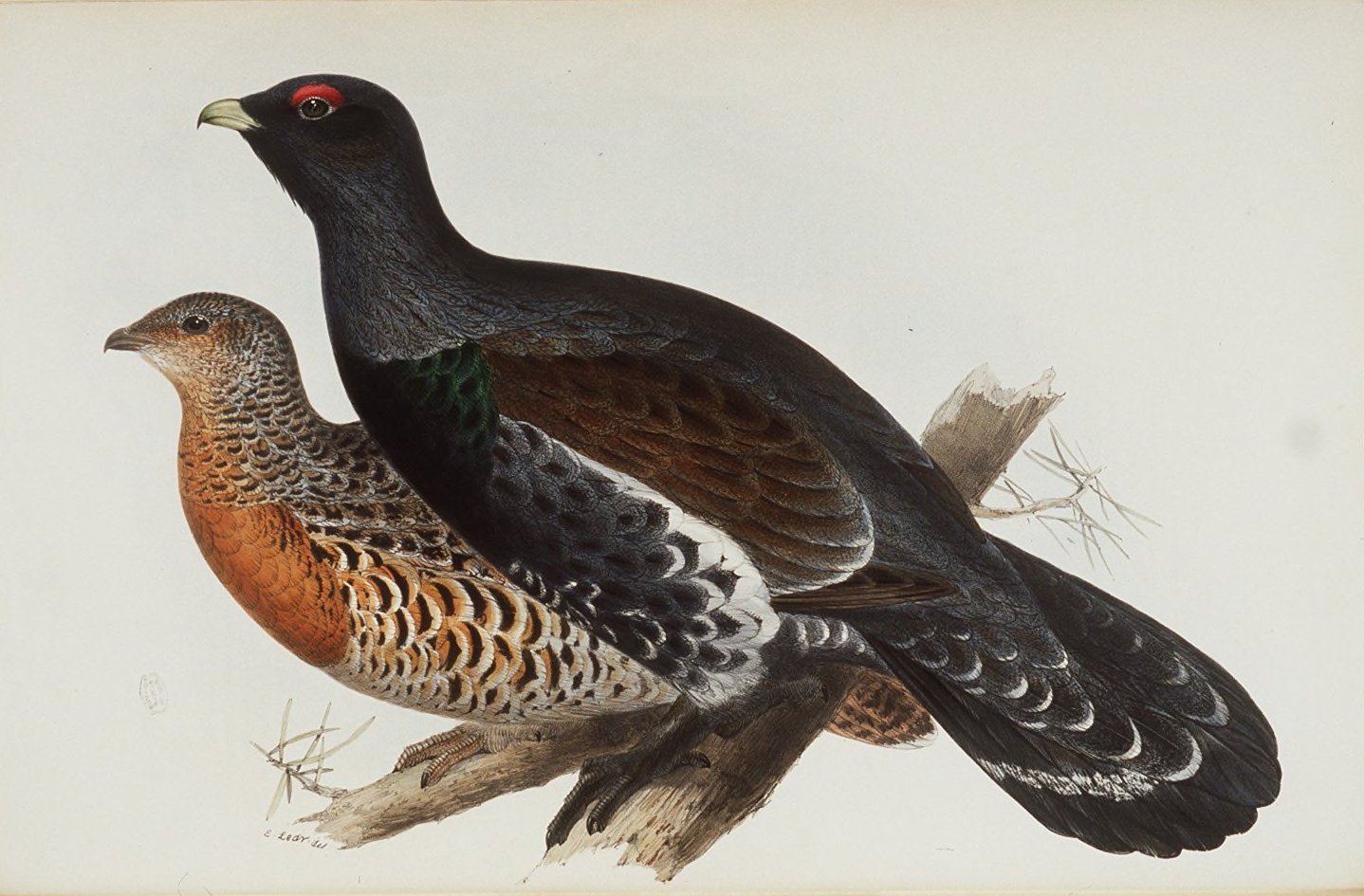
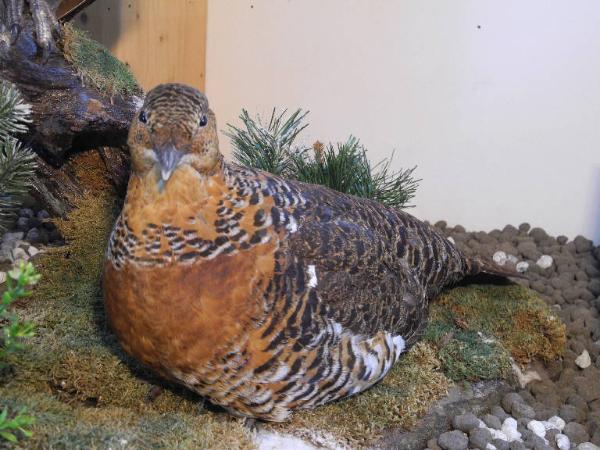
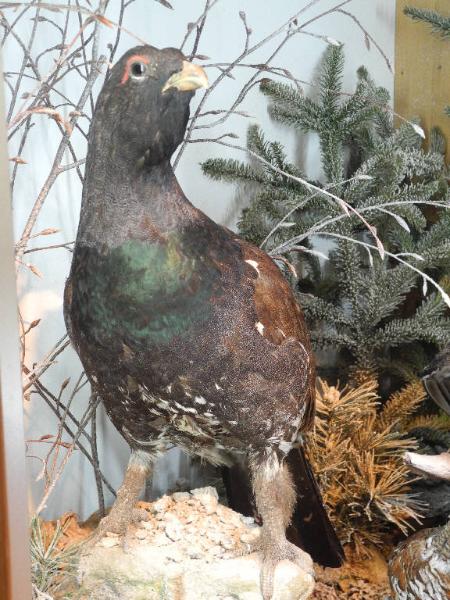
The Fowl Rooster is the largest of the tetraonids and is distinguished by its massive bearing and elaborate plumage. Males, which can reach 86 cm in length, are easily recognizable by their predominant black color, chest with greenish metallic highlights, and long, rounded tail, arranged in a fan shape during courtship. The smaller (about 60 cm) females have reddish-brown, finely barred camouflage plumage and a shorter, rounded tail. This appearance differentiates them from the female black grouse, which is more petite and has less complex plumage.
The grouse's wings are relatively short, with pale undersides, and in flight they generate a rapid, loud beat. The natural habitat of this species is coniferous and deciduous forests in mountainous areas, where it feeds on buds, shoots, berries and occasionally small insects.
During the breeding season, the male puts on a spectacular nuptial parade: perched on an elevated point such as a rock or log, he fans his tail open, raises his head and sings with a series of distinctive sounds to attract females. This behavior, combined with the majesty of its appearance, makes it a fascinating symbol of mountain ecosystems.

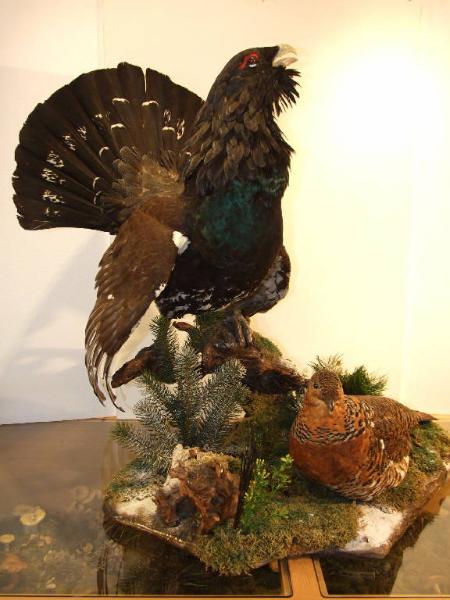
Taxidermied specimen in courtship stage, clearly showing an open tail and partially disclosed wings. This is an adult specimen of capercaillie: the largest bird among the tetraons: measuring in length sixty-five to seventy centimeters, in wingspan one meter and thirty centimeters, has wings forty centimeters, tail thirty-five, and weighs four to five kilograms. As morphologically distinctive characters one can only mention, in comparison with the general rules of the family, the rounded tail and prolonged throat feathers; as then to the dress, it is blackish on the head and throat, ashy-dark with black ripples on the back of the neck, blackish and ashy on the forepart, finely speckled with ashy and rust-brown on the basically blackish back, the wings are brown and black with shades toward rust, the tail black with a few white spots, the breast shiny steel-green, and the rest of the underparts mottled with white and black. The eye is brown, the periocular membrane red, and the beak horny-white.
The specimen in question appears to be in excellent condition and is lying on an artificial stand.
Association “Storia Natura e Vita”
Piazza Camozzi, 2
22010 Grandola ed Uniti (CO) – Italy
VAT ID: IT 03290790132
Tax ID: 93007310134
[email protected]
Project implemented with the support of the PR FESR 2021-2027 of the Lombardy Region, Bando Innovacultura
Questo sito web è stato progettato tenendo conto delle linee guida WCAG 2.1 - level AA
Click the profile that best represents you and we will record your choice.