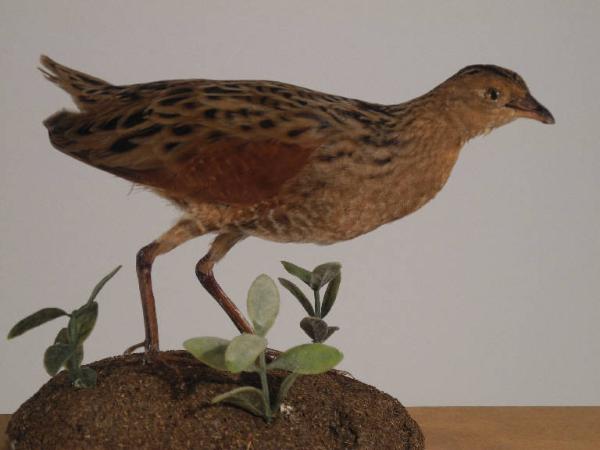
The Corncrake is a medium-sized rallid measuring between 27 and 30 cm in length, with a wingspan ranging between 42 and 53 cm. Males weigh about 165 g, while females are slightly lighter, with an average weight of 145 g.
The plumage of the adult male has a brownish-black top of the head and upper regions, with streaks of chamois or gray. The wing coverts are a distinctive brown color, with white stripes. The neck, face, and breast are blue-gray, with a distinctive light brown stripe extending from the base of the beak to above the eye. The abdomen is white, and the flanks and undertail are marked by white and brown stripes. The beak is strong and flesh-colored, the iris is light brown, and the legs are light gray.
The female is similar to the male, but has warmer-toned plumage in the upper regions and a thinner, less visible supraocular stripe. During the nonbreeding season, the upper regions of both sexes become darker, while the lower regions tend to lose their gray, resulting in less contrast. Juveniles resemble adults, but their plumage has more yellowish hues in the upper regions, while the lower regions are a chamois-brown color. Chicks, like all Rallids, are covered with a black plumage.
No subspecies of Crex crex are recognized, but individual variation in coloration is observed, especially toward the eastern borders of its range, where specimens tend to have lighter, grayish coloration. After nesting, adults make a complete molt that generally ends in late August and early September, before migrating to southeastern Africa. During the winter in Africa, the birds undergo a partial pre-nesting molt involving head, body and tail plumage. Juveniles molt head and body plumage about five weeks after hatching.
In Africa, the corncrake shares its habitat with the African rallo, but differs from the latter in its larger size, lighter upper coloration, and tenné wings. In flight, Crex crex has longer and less rounded wings than the African rallo, with weaker wing beats and a visible white band on the inner surface of the wing. It is easily distinguished from other species of Rallids by its larger size, coloration of the upper regions and length of beak. In flight, its appearance resembles a galliform, but its brown wings and dangling legs make it unmistakable.