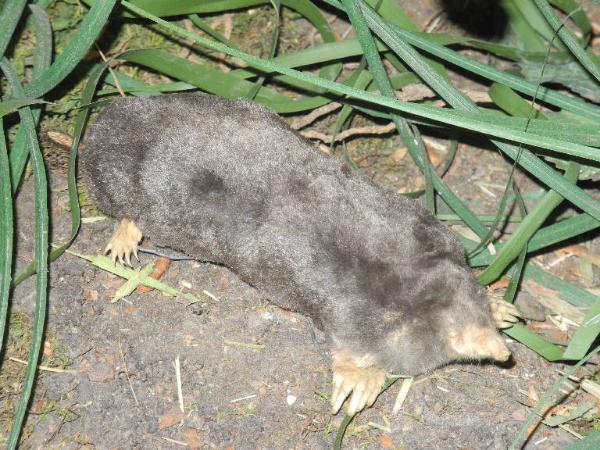
The Mole is a small fossorial mammal belonging to the family Talpidae. It has a body length of 14-16 cm, excluding the tail, which measures between 2.5 and 3.3 cm. The weight of an adult specimen ranges between 60 and 120 g, with a height at the shoulder of 4-5 cm. The body is compact and well adapted to life underground, with fine, velvety fur, usually black in color, but sometimes with brown, gray or bluish highlights. The mole has invisible ears without earpads, and the tip of the nose is a characteristic flesh color.
The mole's morphology is highly specialized for digging: its broad, massive front legs are equipped with short, strong claws that are ideal for digging tunnels. The body has a "streamlined" shape, with a pointed snout and well-protected eyes and ears to defend against total darkness and underground vibrations. In addition, the soft fur allows the body to move easily in tunnels even in the opposite direction, facilitating backward movement.
In terms of differentiation from other mole species, the Talpa europaea is distinguished by its relatively larger size than the Talpa caeca (blind mole) and smaller than the Talpa romana. A distinguishing feature of T. europaea is the absence of fur at the eyes, unlike the Caecal Mole, which is completely blind and without eyes, or the Roman Mole, which has visible eyes. Another distinguishing feature is the mesostyle of the molars, which in T. europaea is rarely bifid and, when it is, appears more rounded than in the Roman Mole.
This mammal lives mainly in wooded environments, meadows and gardens, where it digs underground tunnels to search for food, which consists mainly of invertebrates, such as earthworms, insects and larvae.