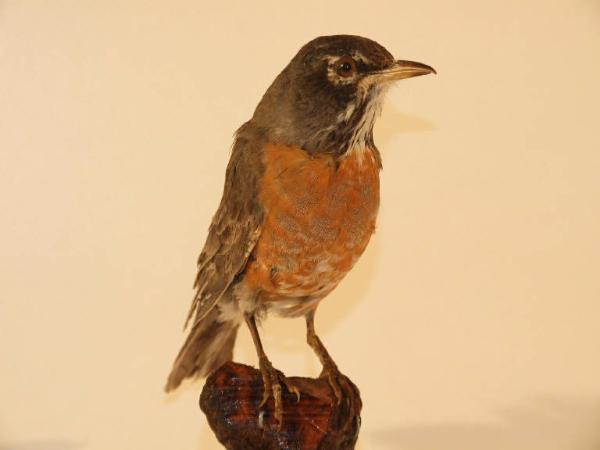
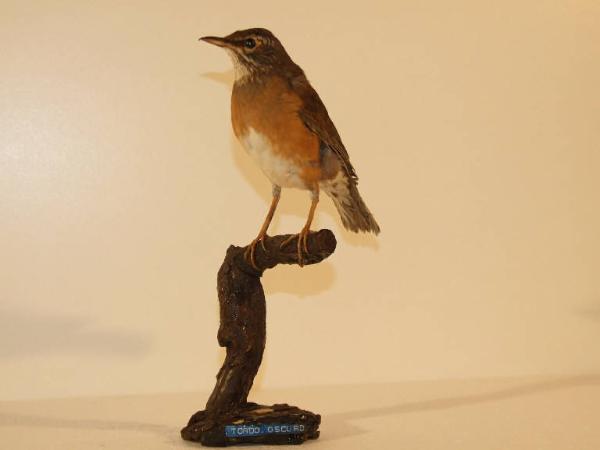
The American Migratory Thrush is a bird in the family Turdidae, known for its migratory ability and beauty. It is one of the most recognizable thrushes in North America, ranging in size from 23 to 28 cm in length. Its plumage is characterized by a grayish-brown head and back, while the belly and chest are a bright orange that is easily distinguished, especially in males, creating a striking contrast with other parts of the body. The underside of the wings and tail are darker in color, tending to brown.
The beak of the migratory thrush is thin and orange-yellow, while the legs are dark brown. The eyes are dark, with an alert and lively expression. The female is similar to the male, but generally has more blurred and less bright colors, especially on the breast.
The American migratory thrush is famous for its seasonal migration, moving from Canada and the northern United States to the southern United States and Mexico during the winter, returning north in the spring for the nesting season. During migration, the thrush moves in groups, often in large flocks, and can be seen in a variety of habitats, from urban areas to woodlands and gardens.
The migratory thrush is a bird that feeds mainly on fruits, berries and insects. It has a melodious song, which consists of a series of clear and varied notes, and is emitted mainly during the nesting season. This bird is known for its lively behavior and varied habitat, and is one of the most common and beloved thrushes in North America.

Taxidermied specimen with wings closed on rigid wooden support (trunk); good condition.
Present from Alaska to Mexico, the American Blackbird winters south of the range as far south as Guatemala. It usually frequents forests, meadows, fields, vegetable gardens and orchards, with a preference for open areas with trees at the edges. The head, back and wings are grayish-brown; the breast is reddish-brown; the belly and lower part of the tail are light-colored; thin whitish longitudinal streaks can be seen on the throat. Social in nature, the American Blackbird aggregates in large groups, especially in the winter period. In the breeding season, which runs from April to July, the female lays 3-5 eggs in a nest located in a tree or in dense bushes, which she hatches for 2 weeks. It feeds on fruits, berries and insects. Other species of thrushes include Turdus obscurus, which lives in the coniferous forests of the Siberian taiga and migrates as far as Southeast Asia in winter, and Turdus ruficollis, with its distinctive reddish-brown bib. Turdus helleri and Turdus swalesi are in danger of extinction due to habitat reduction.
Association “Storia Natura e Vita”
Piazza Camozzi, 2
22010 Grandola ed Uniti (CO) – Italy
VAT ID: IT 03290790132
Tax ID: 93007310134
[email protected]
Project implemented with the support of the PR FESR 2021-2027 of the Lombardy Region, Bando Innovacultura
Questo sito web è stato progettato tenendo conto delle linee guida WCAG 2.1 - level AA
Click the profile that best represents you and we will record your choice.