The Mute is a bird in the family Otididae, which prefers open environments at high altitudes. It is mainly found in alpine areas, where it can be seen mainly near debris or boulders emerging from meadows and in the presence of vegetation consisting of low grasses and seed-producing plants. It does not frequent wooded areas, but prefers sunny rock faces, scree, scree slopes and moraines. The highest concentration of specimens occurs around 2000 meters altitude.
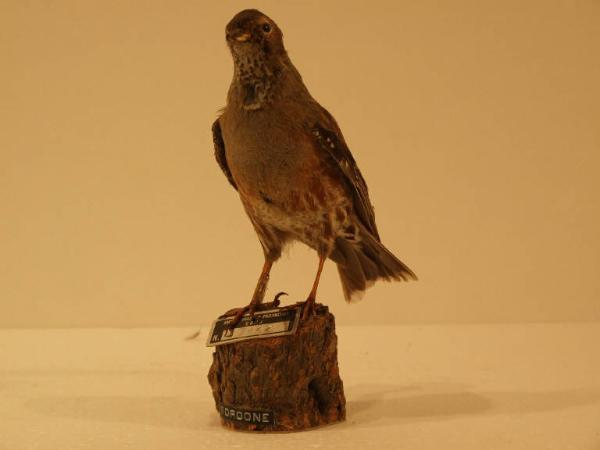
Aesthetically, the mockingbird is sparrow-like, with a length of up to 18 cm. Its grayish-brown plumage, which is particularly compact, blends in with its rocky surroundings, while shades of brown are enlivened by reddish streaks on its flanks. The mute's peculiarity is the black and white patterning on its breast and the numerous white spots on its wings. The legs are reddish in color, and although there are no major differences between the sexes, young specimens have less bright plumage and lack the characteristic white dots. The male, during the courtship phase, performs a series of display behaviors, puffing up his chest and showing his crest of feathers.
The mute is a bird that feeds mainly on the ground, foraging among debris and rocks. It prefers spiders, insects, other invertebrates, seeds, small fruits and mollusks, but may sometimes feed on human waste near small villages. During the breeding season, the dominant male, after chasing away other suitors, mates with several females. Females lay two broods per year, with the first one occurring in late spring. The nest is built between cracks in rock walls or among boulders, using dry grass, stems and moss. The eggs, which are light blue in color, number 4-5 and are incubated for about two weeks by both parents. The chicks, which hatch between July and August, leave the nest after about 16 days. A second brood may occur in July-August.
This species is widespread in northwestern Africa, the Iberian Peninsula, Italy, and the Balkans, reaching as far as Turkey and the Himalayas. In Italy, the mute is found throughout the Alps and in some areas of the Apennine ridge, such as the northern part between Emilia and Tuscany, and the central area that includes Abruzzo. No precise information is available regarding its presence in the southern Apennines.